I have been roofing in Phoenix through every monsoon season since 2001. Some years bring a handful of storms and manageable damage. Other years — like 2021 and 2023 — we field hundreds of calls in a week after a single major metro event. The homeowners who fare best are the ones who know what to do before the season starts and what not to do immediately after a storm. This guide covers both.
Monsoon Season Timeline in Arizona
Official monsoon season runs June 15–Sept 30. Peak storm activity is July 15–mid-September. Most significant roof damage events occur in this peak window.
The National Weather Service defines Arizona monsoon season as June 15 through September 30. The defining weather pattern is a shift in the low-level winds from west/southwest to south/southeast — this moisture flow from the Gulf of Mexico and Gulf of California fuels the convective storms that define Phoenix summers.
In practice, most of the significant roof damage events we respond to occur in the peak activity window: July 15 through mid-September. Early June storms exist but are typically lighter. The most severe events — the haboobs, the derecho-style wind events, the intense convective cells that produce 60+ mph gusts and 2+ inches of rain in 30 minutes — peak in late July and August.
| Period | Storm Intensity | Roof Damage Risk |
|---|---|---|
| June 15 – July 14 | Developing — some storms possible | Low to moderate |
| July 15 – August 31 | Peak — most significant events | High |
| September 1 – September 30 | Active — intense cells still possible | Moderate to high |
| October – November | Trailing events — rare but possible | Low |
What Phoenix Monsoon Season Does to Roofs
Wind, water overload, and hail each attack roofs differently. Understanding which type of damage occurred guides the right repair approach.
Wind Damage Patterns
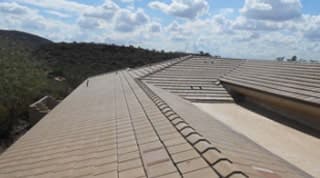
High-velocity monsoon winds attack roofs at predictable failure points. Ridge caps — the tiles or shingles at the peak of the roof — are exposed on both sides and have the highest wind loading. Ridge cap tiles that were set in cracked or deteriorated mortar are lifted first. After ridge caps, the wind works down to hip tiles (the angled edge tiles on corner ridges) and any section where an existing repair or installation created a wind catch.
On shingle roofs, wind damage typically manifests as lifted shingle tabs. Shingles are designed to resist wind uplift through adhesive sealant strips — but those strips lose effectiveness as shingles age, particularly in Arizona's UV environment. A 15-year-old shingle in Phoenix may have minimal adhesive strength remaining. 60 mph gusts are more than enough to lift sections that were holding fine in calm conditions.
Flat roofs under high wind are vulnerable at the perimeter — the membrane edges and parapet flashings are the primary wind-failure points. A flat roof with well-maintained perimeter flashings typically handles monsoon winds without issues. One where the edge metal has lifted or the parapet coping has failed is a wind-damage waiting to happen.
Water Intrusion Patterns
Two inches of rain in 30 minutes is a 4-inch per hour rainfall intensity. Most residential drainage systems — gutters, scuppers, downspouts, and roof slope — are designed for 2–3 inches per hour in Arizona. When the storm exceeds that design rate, water backs up on the roof surface and finds its level. If there are any penetration failures, cracked tile, or failed underlayment, that backed-up water finds them.
Flat and low-slope roofs are particularly vulnerable to this pattern. The flat-roof homes common in Tempe near ASU, in central Glendale, and throughout older Phoenix neighborhoods depend on drains and scuppers to evacuate water fast. A drain that has not been cleared in two years and is packed with leaf debris can cause a flat roof to pond 3–4 inches of standing water during a hard monsoon — that much water will find any weakness in the membrane.
On pitched tile roofs, the most common water intrusion path after a monsoon is through failed pipe boot flashings or HVAC curb flashings that were compromised before the storm. The storm does not create the failure — it exposes it. These are preventable with pre-season maintenance.
Hail Damage by Roof Type
Hail is less common in central Phoenix than in the eastern Valley — the hail-active corridor runs through Chandler, Gilbert, Mesa, and Queen Creek. When it does occur, it damages different materials differently.
Tile
Hail damage is subtle and often invisible from street level: hairline fractures that radiate from the impact point. These cracks do not allow immediate water infiltration, but they propagate under thermal cycling. By the following monsoon season, hairline cracks are often full breaks. A post-hail tile inspection requires walking the roof.
Shingle
Impact marks (dark bruises or spatter patterns) on shingles indicate granule displacement. Shingles that have lost significant granule coverage from hail accelerate toward failure. Your insurer's adjuster will look for these patterns; we can document them for your claim.
Foam / flat roof
Hail on foam creates small divots in the elastomeric coating. Minor hail on well-maintained foam is typically not a serious issue. Large hail can breach the coating and expose the foam core to UV — this requires professional assessment and localized repair.
Pre-Monsoon Season Prep Checklist
A pre-monsoon inspection in May or June catches the failure points that storms will find first. Addressing them proactively costs a fraction of emergency repair.
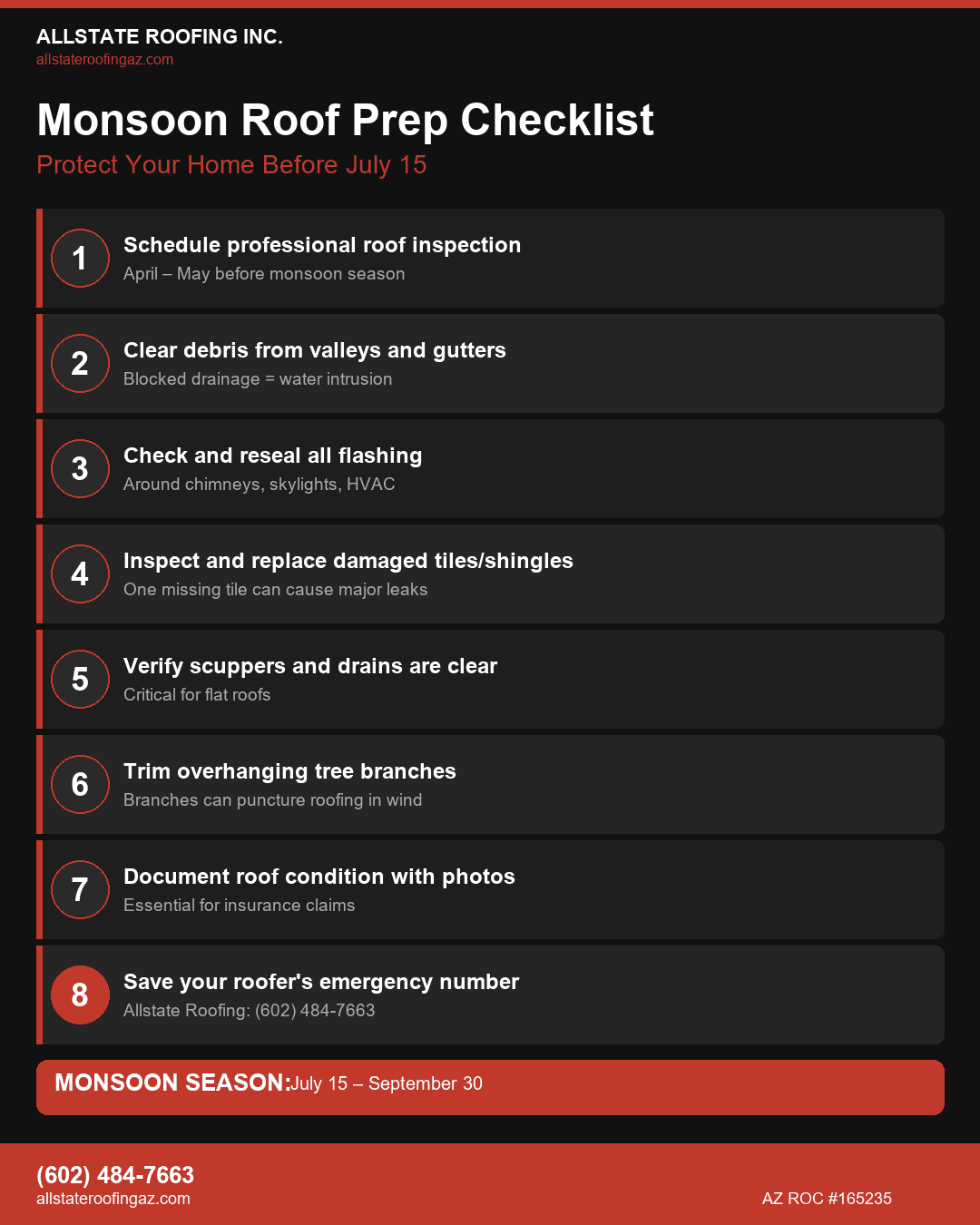
The best monsoon storm response is the inspection you do before the season starts. I recommend a pre-monsoon assessment every year for any Phoenix home — particularly for homes with tile roofs from the 1990s or 2000s, and for flat-roof homes in central Phoenix, Tempe, and Glendale. Here is the checklist we use:
- 1Inspect ridge cap mortar. Check for cracking, gaps, or displaced ridge cap tiles. Cracked mortar is the most common cause of wind-displaced tiles during monsoons.
- 2Inspect hip tile mortar and edge tiles. The perimeter of the roof is the highest wind-loading zone.
- 3Check all pipe boot flashings. The rubber boot around vent pipes degrades in UV and cracks. A cracked pipe boot on a pitched-roof home is the most common source of post-monsoon leaks.
- 4Check HVAC curb flashings. Caulked HVAC curb flashings dry out and crack in Arizona heat. Inspect and re-caulk if deteriorated.
- 5Clear flat roof drains and scuppers. A flat roof drain clogged with debris is a standing-water event waiting to happen. Flush drains with a hose to confirm flow rate.
- 6Clear gutters and downspouts. Debris in gutters causes water to back up at the eave — a common intrusion point on shingle roofs.
- 7Check skylight flashing seals. Skylights are common leak points. Inspect the flashing on all four sides and re-seal any gaps.
- 8Walk the perimeter at ground level looking for visibly cracked or displaced tile. Any tile that appears lifted, cracked, or out of alignment should be addressed before July.
Immediate Steps After a Monsoon
Document first, protect second, call your insurer third, call a licensed roofer fourth. Do NOT get on the roof. Do NOT sign anything from an unsolicited contractor.
- 1Document the damage with photos before anything else — ground-level shots are sufficient to start a claim. If you can do so safely, get photos of the visible damage from the street.
- 2If water is actively entering your home, move valuables and furniture away from the affected area and place buckets.
- 3Call your insurance company if you believe a claim is appropriate — do this before authorizing any permanent repairs.
- 4Call Allstate Roofing at (602) 484-7663 for a damage assessment and, if needed, emergency tarping.
- 5Do NOT get on the roof. Wet roofs, storm debris, and compromised sections create fall hazards.
- 6Do NOT sign any contract presented by an unsolicited contractor who came to your door.
Insurance Claim Process for Monsoon Damage
Sudden storm damage is covered. Gradual wear exposed by the storm is not. File before authorizing permanent repairs — adjuster inspection is required for the claim to process.
The insurance claim process after a monsoon event follows a specific sequence. Getting out of order is the most common mistake homeowners make — and it can reduce or eliminate your coverage.
- 1
File the claim immediately
Call your insurance company or file online as soon as you have documented the damage. Most policies have reporting windows — check yours. The sooner you file, the sooner the adjuster is assigned.
- 2
Get temporary protection approved
Ask your insurer whether emergency tarping costs will be covered under your claim. Most policies allow temporary mitigation costs. Get approval before authorizing tarping.
- 3
Schedule the adjuster visit
Your insurer will send an adjuster. Do not proceed with permanent repairs until after the adjuster inspection. The adjuster needs to see undisturbed damage to process the claim correctly.
- 4
Get the adjuster scope and payment estimate
The adjuster will produce a scope of work and payment estimate (minus your deductible). Review it carefully — if you believe the scope is incomplete, you can request a re-inspection or hire a public adjuster.
- 5
Authorize permanent repair
Once you have the insurance scope and payment in hand, authorize the repair. We work directly with insurance claims and provide all documentation the insurer needs to process payment.
The Storm Chaser Problem in Phoenix
After every major Phoenix monsoon, out-of-state storm chasers descend on the metro. Verify any contractor at azroc.gov before signing. No Arizona address and no verifiable license are immediate disqualifiers.
After every major Phoenix monsoon event, licensed Arizona roofers compete for work alongside storm-chasing contractors from Texas, Oklahoma, Colorado, and elsewhere who descend on the metro. This is a documented pattern, tracked by the Arizona Registrar of Contractors.
Storm chasers typically arrive within 24–48 hours of a storm, claim they "saw damage from the street," offer to file the insurance claim on your behalf (which requires a licensed public adjuster in Arizona — most storm chasers do not have one), and pressure for a contract signature and large deposit immediately. The work, when performed, is often temporary or substandard — done fast to capture as many jobs as possible before the crew moves to the next storm city.
How to Verify Any Roofing Contractor
- Ask for the AZ ROC license number and verify it at azroc.gov before signing anything
- A valid Arizona CR-42 contractor license is required for all residential roofing work
- Check that the license holder name matches the company name — storm chasers sometimes use shell LLCs
- Ask for the business's physical Arizona address — not a P.O. box or hotel room
- Search the license number for any complaints at azroc.gov/complaints
- Never sign a contract with a large upfront deposit before materials are ordered
- Do not let anyone file an insurance claim on your behalf without verifying they hold an Arizona public adjuster license
Allstate Roofing is AZ ROC #165235. Verify at azroc.gov. We have been licensed and operating in Phoenix since 2001.
What Monsoon Damage Typically Costs to Repair
Most post-monsoon residential repairs fall in the $400–$3,000 range. Emergency scheduling carries a 25–40% surcharge.
Most post-monsoon residential repairs in Phoenix fall in the $400–$3,000 range. Emergency scheduling (within 24–48 hours of a call) carries a 25–40% surcharge over standard rates. Common scope items:
| Repair Type | Standard Rate | Emergency Rate |
|---|---|---|
| Ridge cap mortar reset + tile re-set | $400–$1,500 | $550–$2,100 |
| Hip tile repair (displaced or cracked) | $350–$900 | $490–$1,260 |
| Shingle wind lift repair (small–medium) | $400–$1,500 | $550–$2,100 |
| Pipe boot / vent flashing replacement | $200–$450 | $280–$630 |
| Flat roof drain repair / clearing | $300–$700 | $420–$980 |
| Emergency tarping (temporary) | $200–$500 | $200–$500 |
| HVAC curb flashing re-seal | $300–$700 | $420–$980 |
For insurance-covered work, the repair is billed at the insurer-approved rate after the claim is processed. We provide all documentation for claims. See our pricing guide for full repair cost ranges, or visit our emergency roof repair service page.
Monsoon Damage FAQs
What should I do immediately after a monsoon damages my roof?
Document the damage with photos before anything else — ground-level shots are sufficient to start a claim. Move valuables away from any ceiling leaks. If water is actively entering, place buckets and call (602) 484-7663 rather than submitting a web form. Do not get on the roof yourself — wet roofs are dangerous.
Does homeowners insurance cover monsoon roof damage in Arizona?
Most homeowners policies cover sudden storm damage including monsoon wind, hail, and falling debris. What is typically not covered: gradual deterioration that the storm exposed, lack of maintenance, and pre-existing damage. File your claim before authorizing any repairs — the adjuster needs to inspect the undisturbed damage.
How do I identify a storm-chasing contractor vs. a legitimate roofer?
Storm chasers arrive unsolicited, often the day after a storm, and pressure you to sign immediately. They typically have no Arizona address, no verifiable license, and want a large deposit before starting. Ask for the AZ ROC license number and verify it at azroc.gov before signing anything. Allstate Roofing is AZ ROC #165235 — you can verify us directly.
How quickly can Allstate Roofing respond to monsoon damage?
We prioritize emergency calls during monsoon season. Response time varies with storm volume — after a major metro-wide storm, response times can extend 3–7 days due to demand. Emergency tarping is available to protect your interior while permanent repairs are scheduled. Call (602) 484-7663 for the fastest response.
When does Phoenix monsoon season start and end?
Arizona officially defines monsoon season as June 15 through September 30. In practice, the most active storm period runs July 15 through mid-September. June storms exist but are typically less intense. The peak of storm activity — the events most likely to cause significant roof damage — runs from the last week of July through September.
What pre-monsoon roof maintenance should I do each year?
Before July 15: have your ridge cap mortar inspected and any cracked sections reset; clear all flat roof drains and scuppers; check HVAC curb flashing; inspect pipe boot sealants; clear roof-mounted debris. On tile roofs, walk the perimeter from ground level and look for displaced or visibly cracked tiles. If you have a flat roof with interior drains, flush them with a hose to confirm flow rate.
Is hail common in Phoenix during monsoon season?
Hail is less common in central Phoenix than in the eastern Valley storm corridor — Chandler, Gilbert, Mesa, Queen Creek, and San Tan Valley see hail more frequently. Golf-ball to baseball-sized hail is possible in those areas during intense monsoon cells. Hail damage on tile is often hairline fractures not visible from the street. If your area experienced hail, have a licensed contractor inspect before the next storm season.