I started roofing in Phoenix at 15 years old, working alongside my father who held one of Arizona's earliest roofing licenses. That was 40 years ago. Today, as owner of Allstate Roofing, I still personally assess every major repair job. The pricing data in this guide comes directly from real jobs our crew has completed across the Phoenix metro in 2025–2026.
Roof Repair Cost by Type — Phoenix Metro 2026
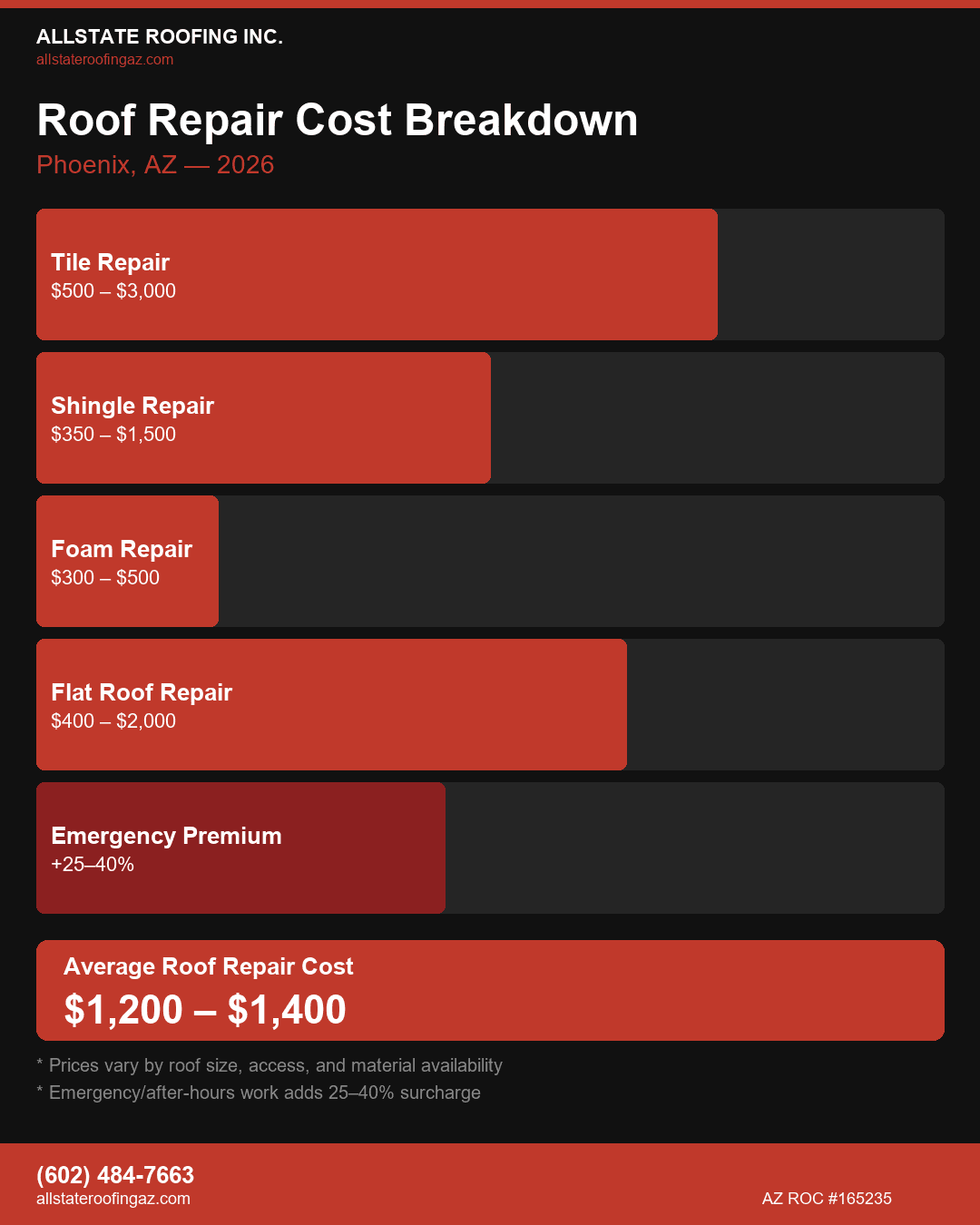
Prices in Phoenix run $350–$3,000 for most residential repairs, depending on material, scope, and urgency.
The following ranges reflect actual pricing from jobs completed across the Phoenix metro in 2025–2026. These are our typical ranges — your actual quote depends on access, crew time, material availability, and any underlying issues discovered during repair. I am providing these numbers so you can spot-check a quote you receive from any contractor, not just us.
| Repair Type | Price Range |
|---|---|
| Minor tile repair (1–5 tiles) | $350–$700 |
| Tile repair (6–20 tiles) | $600–$1,500 |
| Tile repair (20+ tiles / large section) | $1,200–$3,000 |
| Shingle repair (small section) | $350–$800 |
| Shingle repair (large section / ridge) | $700–$2,000 |
| Pipe boot / vent flashing replacement | $200–$450 |
| Skylight flashing repair | $400–$1,000 |
| HVAC curb flashing repair | $400–$900 |
| Valley metal replacement | $500–$1,500 |
| Ridge cap mortar reset | $400–$1,200 |
| Foam roof recoat (per sq ft) | $2.00–$4.00 |
| Foam roof repair (section) | $400–$1,500 |
| Modified bitumen blister repair | $300–$900 |
| Flat roof drain repair / replacement | $400–$1,200 |
| Emergency tarping (temporary) | $200–$500 |
Minor, Mid-Size, and Major Repairs — What Each Scope Involves
Minor repairs run $350–$800, mid-size $800–$2,500, major repairs $2,500–$5,000+ — scope drives cost more than material alone.
Minor Repairs ($350–$800)
A minor repair typically means one failure point on an otherwise sound roof. Common examples: a pipe boot that has cracked around a vent stack, three displaced tiles after a windstorm, a small shingle section that lifted along the ridge. The crew accesses the roof, addresses the specific failure point, and is done in a few hours. These jobs are generally the clearest value in roofing — a $500 repair today prevents the $5,000 water damage bill that follows an ignored leak.
My honest advice: do not delay minor repairs in Phoenix. The dry season makes it easy to assume a small crack "is not leaking yet." Then July monsoon season arrives and two inches of rain in 30 minutes finds every weakness in your roof simultaneously.
Mid-Size Repairs ($800–$2,500)
Mid-size repairs involve multiple failure points, a larger section of roofing material, or a problem that requires removing and reinstalling adjacent material to reach the source. Examples: a 10-tile section that lifted in a monsoon and needs all tiles removed, underlayment inspected, and tiles reinstalled; a skylight with flashing failure on multiple sides; an HVAC curb with failed caulking at all four corners; a flat roof drain that has failed and caused a ponding section.
The challenging part of mid-size repairs is scope uncertainty. What looks like a localized tile issue sometimes reveals failed underlayment beneath it when we pull the tiles. We always document what we find and get your sign-off before expanding scope. No surprises on your bill.
Major Repairs ($2,500–$5,000+)
Major repairs approach the territory where a replacement conversation is worth having. Examples: widespread ridge cap failure across a large hip-and-valley roof, significant underlayment failure in a defined zone, foam roof damage from a major impact event, or a shingle roof with multiple large sections requiring replacement. At this repair scope, we give you both the repair cost and the replacement cost in writing so you can make an informed decision about what makes sense for your specific situation and timeline.
What Drives Roof Repair Costs Higher in Arizona
Emergency timing, pitch, and hidden decking damage are the three most common cost drivers beyond the base repair scope.
1. Emergency Scheduling (25–40% Surcharge)
Emergency repairs — jobs scheduled within 24–48 hours due to active leaks or urgent storm damage — carry a 25–40% surcharge over standard rates. This reflects the real cost of rescheduling crews and expediting material procurement. A $700 repair at standard rates may cost $875–$980 on emergency scheduling. After a major metro-wide monsoon event, every licensed Phoenix roofer is handling this same demand spike simultaneously.
If your situation can wait even 48–72 hours after a storm, the standard rate applies. Emergency tarping ($200–$500) to protect the interior while you schedule a standard repair is often the smarter financial move.
2. Roof Pitch and Access
Steep pitch roofs (greater than 6:12 slope) require additional safety equipment, a slower work pace, and more crew members for material staging. In the Phoenix metro, most homes have low to moderate pitch roofs — but Scottsdale, Paradise Valley, Fountain Hills, and Cave Creek custom homes frequently feature steeper pitches that add $300–$1,000+ to any job. Multi-story homes add a similar premium for scaffolding or extended ladder access.
3. Decking Damage
When a repair requires removing roofing material, the decking condition becomes visible. Rotted or deteriorated OSB or plywood decking adds $3–$8 per square foot to replace. On older Phoenix-area homes where a long-standing slow leak has saturated the deck, a repair that started as "simple tile work" can uncover several hundred square feet of compromised decking. We always document decking conditions and get your approval before proceeding with any scope beyond the original repair.
4. Material Matching
Tile profile matching for partial repairs can add cost — we may need to source tile through specialty distributors or adjust the repair approach if an exact match is unavailable. This is common on Phoenix-area homes from the late 1980s and 1990s where the original tile profile has been discontinued. On shingle roofs, matching a specific product that was discontinued adds a premium over using a currently-available equivalent.
5. Monsoon Season Demand Surge
Phoenix monsoon season runs officially June 15 through September 30. The peak activity window — July 15 through September 30 — generates the highest volume of repair calls of any period in our calendar. After a significant metro-wide storm event, wait times for repair appointments extend. Material suppliers also see increased demand. If you know your roof has deferred maintenance heading into summer, getting it addressed in May or early June avoids the monsoon pricing and scheduling premium.
The Repair-First Philosophy
Allstate Roofing was built on repair-first: we recommend replacement only when repair is genuinely not the cost-effective answer.
We built Allstate Roofing on a repair-first approach: if a targeted repair will solve the problem and extend the life of the system meaningfully, that is what we recommend. We will not tell you that you need a full replacement when a repair is the honest answer.
That said, there are situations where repair is the wrong call. If underlying causes are pervasive — failed underlayment across 60% of the roof, systemic granule loss indicating end-of-life shingles, foam surface degradation with core damage — repair money is better spent on a full replacement. The way to tell the difference is an honest on-site assessment, not a phone estimate or a Google search.
When we complete a free assessment and the answer is "you need a full replacement," we will tell you that clearly, explain why in terms you can see and understand, and give you a written replacement quote. We will also tell you if the repair option is viable and what the cost difference is. The decision is yours — our job is to give you accurate information to make it.
How we estimate
Free on-site assessment. We access the roof, document all visible damage, check flashing at every penetration, assess underlayment condition where accessible, and provide a written scope with itemized pricing. No charge, no pressure. Call (602) 484-7663 or visit our contact page.
Red Flags in Roof Repair Estimates
An estimate given without a physical roof inspection is not an estimate — it is a guess. Never sign a repair contract without an itemized scope.
After 25 years in Phoenix roofing, I have seen every variety of bad estimate. Here is what to watch for:
- Phone or photo-only estimates: Any contractor quoting you a repair price without physically accessing your roof is guessing. Real repair costs depend on conditions that cannot be assessed from the ground or from photos.
- Same-day pressure: A legitimate roofer does not need you to sign today. If someone is pressuring you to commit before the estimate expires or before you can get a second opinion, that is a red flag.
- No itemized scope: A single-number estimate with no breakdown tells you nothing about what work is being done, what materials are being used, or what is explicitly excluded. An itemized scope protects you.
- No AZ ROC license number on the paperwork: Every Arizona roofing contractor is required to have a CR-42 license. If the license number is not on their estimate or contract, ask for it and verify at azroc.gov.
- Unusually low quotes: Quotes significantly below market range often mean something is excluded — decking inspection, material matching, permit fees, or workmanship warranty. Ask what is not included.
Questions to Ask Before Authorizing a Repair
The right questions before signing protect you from scope surprises and ensure you know exactly what you are paying for.
- What exactly is included in this price — labor, materials, disposal?
- If you find rotted decking when you open up the section, what is the cost per square foot, and do I get a call before you proceed?
- What material will you use for the patch — manufacturer, product name, color code for tile or shingle?
- Will you document the roof condition before and after the repair?
- What is the warranty on the repair labor? How long and what does it cover?
- Can you provide proof of your AZ ROC license and a current insurance certificate naming me as additionally insured?
- Is this price the same if I schedule for next week versus scheduling as an emergency?
When to Repair vs. When to Replace
Localized damage means repair. Systemic failure across the roof means replacement. The honest assessment is what matters, not the higher-dollar option.
The most common scenario where I recommend repair: damage is localized to a specific section, the rest of the roof is sound, and the repair will restore the system integrity for 5–10+ more years. In these cases, spending $500–$2,000 on a targeted repair beats a $10,000–$20,000 full replacement.
The scenarios where I recommend replacement instead:
- Tile underlayment that is failing across the majority of the roof — a patchwork of repairs on failed underlayment is money spent badly. A full Tile R&R (removal and replacement of underlayment while reinstalling your existing tile) is the correct solution.
- Shingles at or past their Phoenix lifespan (20–25 years) showing widespread granule loss. Individual section repairs on end-of-life shingles are temporary — the whole system is failing.
- Foam roof with widespread coating degradation that has allowed UV to reach the foam core. Once the core is compromised, repair costs more than recoating would have.
- Multiple failure points across different sections of the roof — when you are repairing a third or fourth location, the cost of the repairs is approaching or exceeding the replacement cost and you have none of the warranty protection of a new roof.
See our full replacement cost guide if you are trying to evaluate that option, or visit the pricing page for a full service breakdown.
Insurance Coverage for Roof Repairs in Arizona
Storm damage from wind, hail, or debris is typically covered. Wear, age, and maintenance neglect are not. File before authorizing permanent repairs.
Most Arizona homeowners policies cover sudden damage from a storm event — monsoon wind, hail, falling tree branches, or other debris. What is typically not covered: gradual deterioration, lack of maintenance, pre-existing damage, and "wear and tear." The distinction matters significantly when the storm reveals damage that was already developing.
If a monsoon or other storm event caused the damage, follow this order:
- 1Document the damage with photos and video before anything is disturbed.
- 2Call your insurance company and file the claim — do this before authorizing permanent repairs.
- 3Your insurer will send an adjuster to inspect. Do not proceed with permanent repair until after the adjuster visit.
- 4Get the insurance scope and payment estimate in writing.
- 5Then call us. We work directly with insurance claims, provide documentation, and match the work to the approved scope.
For insurance-covered work, your cost is your deductible — the insurer pays the rest at the approved rate. The potential cost difference is significant if you have coverage. Never skip the claim and pay out of pocket before confirming whether the damage qualifies.
Cost Guide FAQs
What is the average cost of roof repair in Phoenix, AZ?
The average roof repair in Phoenix runs $350–$1,500 for most homeowners. Minor repairs (a few tiles, small shingle sections, a pipe boot flashing) fall in the $350–$800 range. Mid-size repairs involving larger sections or multiple penetrations run $800–$2,500. Major repairs approaching re-roof territory run $2,500–$5,000+. The best way to get an accurate estimate is a free on-site assessment.
Why is my roof repair quote higher than what I expected?
Several factors push repair costs above the base range: emergency or same-week scheduling (25–40% surcharge), high roof pitch requiring additional safety equipment, multiple access points for a complex roofline, rotted decking discovered during the repair, and proximity to Scottsdale or north Valley luxury markets where crew time and material costs are higher.
Can I repair my own roof in Arizona?
Technically, a homeowner can do minor maintenance like applying sealant or replacing a few shingles without a license. However, any structural repair or work that involves removing and replacing roofing material at scale requires a licensed contractor in Arizona. More practically: Arizona roofs are dangerous. Surface temperatures hit 170°F in summer. Fall hazards on a sloped tile roof are serious. We strongly recommend licensed professional repair for anything beyond basic visual inspection.
How do I know if I need a repair or full replacement?
If the damage is localized — a specific section of missing tiles, a failed flashing at one penetration, wind damage at the ridge — repair is usually the right answer. If the underlying cause is pervasive — widespread underlayment failure, systemic granule loss on shingles, foam surface degradation across the full roof — replacement is more cost-effective long-term. We give you both options in writing with honest assessment.
Does monsoon season affect roof repair pricing in Phoenix?
Yes. During and immediately after a major monsoon event, demand for emergency repairs spikes across the Phoenix metro. Scheduling delays of 3–7 days are common after a significant storm. Emergency scheduling carries a 25–40% surcharge over standard rates. If your repair can wait until the storm season settles (typically October), you may see better pricing and faster scheduling.
What red flags should I watch for in a roof repair estimate?
Watch for: no physical inspection before quoting (estimates given over the phone or from photos alone are unreliable), pressure to sign the same day, no itemized scope (just a single total number), very low quotes that do not account for decking inspection or material matching, and no Arizona ROC license number. Verify any contractor at azroc.gov before signing.
What questions should I ask before authorizing roof repair?
Ask: What is the scope of work in writing? Does this price include decking repair if needed, or is that additional? What brand/profile of tile or shingle will you use for the match? Will you document before-and-after conditions? What is the warranty on the repair labor and materials? Can you provide proof of your AZ ROC license and insurance certificate?