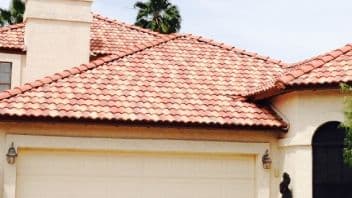
I have installed tile on a $400,000 Chandler home and shingles on a central Phoenix rental property in the same week. The right answer depends entirely on the specific home, the HOA, the budget, and the ownership horizon. Here is how I actually think through this decision for every homeowner I sit across from.
Why This Decision Is Different in Arizona
Arizona adds climate performance and HOA compliance as mandatory evaluation factors — most national tile-vs-shingle comparisons miss both.
In most of the country, the tile vs shingle comparison is primarily about budget and aesthetics. In Arizona, the question has a third dimension: climate performance. Roof surface temperatures of 170°F in July, UV intensity that degrades asphalt 40% faster than temperate regions, and monsoon seasons with 60 mph wind gusts and 2-inch rain events in 30 minutes — these conditions separate materials in ways that national comparisons miss entirely.
Then there is the HOA factor. Approximately 45–50% of Phoenix metro homeowners live under an HOA. In most planned communities — the subdivisions that define the east Valley, north Scottsdale, and the newer northwest Valley communities — tile is not a preference; it is a recorded covenant. Choosing shingles in these communities without written HOA approval means potential fines and a forced reinstallation.
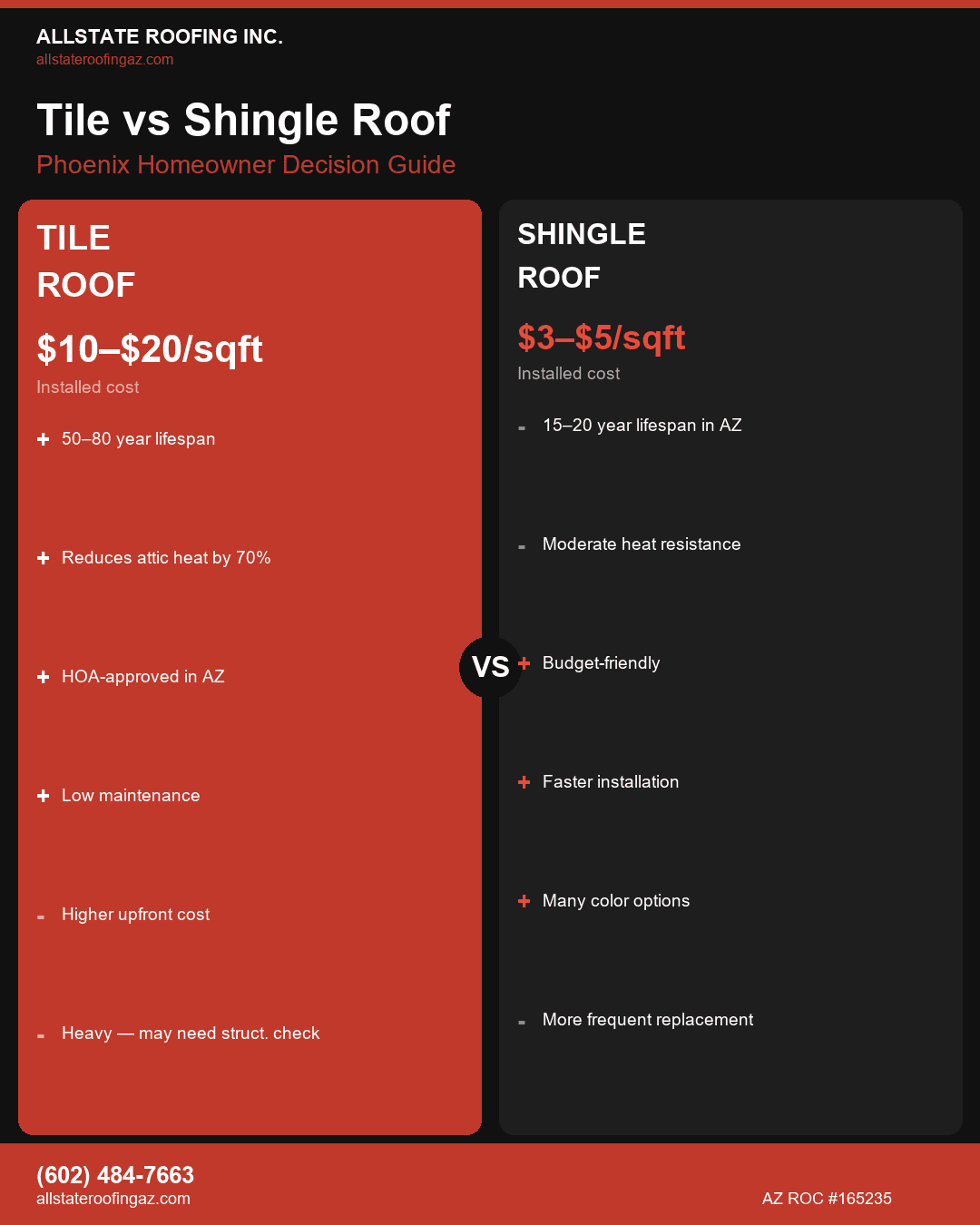
Side-by-Side Comparison
| Category | Tile | Shingle |
|---|---|---|
| Lifespan (Phoenix) | 30–50 yrs (concrete) / 50–80 yrs (clay) | 20–25 years |
| Install Cost | $10–$22 / sq ft | $6–$12 / sq ft |
| Cost Per Year (est.) | $0.28–$0.55 / sq ft over lifespan | $0.32–$0.60 / sq ft over lifespan |
| Heat Performance | Excellent — air gap insulation; 70% less attic heat transfer vs shingle | Moderate — absorbs more heat; no air gap benefit |
| Monsoon Wind | Very good when mortared; ridge caps require maintenance | Good if properly fastened; adhesive sealant degrades with age |
| HOA Compliance | Standard in most Valley HOAs — required in most planned communities | Permitted in select communities; common in older infill neighborhoods |
| Weight | Heavy — 8–12 lbs/sq ft; requires verified framing | Light — 2–4 lbs/sq ft; suitable for all standard framing |
| Fire Rating | Class A | Class A (fiberglass-based arch. shingles) |
| Repair Ease | Individual tiles replaceable; profile matching required for repairs | Section repair straightforward; standard material |
| Maintenance Cycle | Tile R&R every 15–20 yrs (underlayment); mortar inspection every 5–7 yrs | Full replacement every 20–25 yrs; minimal maintenance between replacements |
| Resale Value Impact | Expected standard in most Phoenix metro neighborhoods | Neutral in shingle-norm neighborhoods; negative in tile-dominant markets |
| Insurance Rates | Class A fire rating; may qualify for wind-resistance discount in some policies | Class A fire rating; Class 4 impact-resistant shingles lower rates in hail corridors |
Heat Performance — The Arizona Factor
Tile creates a passive air gap that reduces attic heat transfer by up to 70% vs shingle. In Phoenix summers, this translates to real HVAC savings.
The single biggest performance difference in the Phoenix climate is thermal behavior. Concrete and clay tile sit on top of battens, creating an air gap between the tile and the decking below. That air gap acts as a passive insulating layer — reducing heat transfer into the attic even when the tile surface is radiating heat at 160–170°F.
Asphalt shingles lie flat against the decking with minimal air gap. The asphalt itself absorbs heat and transfers it directly into the roof deck. On a July afternoon, shingle roof decking runs measurably hotter than tile roof decking under identical sun exposure.
This translates to real HVAC costs. Phoenix homes with tile roofs consistently show lower cooling loads than equivalent shingle homes. The energy efficiency benefit of tile is not cosmetic — it is a function of physical installation that creates a thermal buffer that shingles cannot replicate.
Lifespan and True Cost Over Time
Shingles cost less upfront. Over a 50-year horizon, concrete tile often costs less per year because the tile itself outlasts two to three shingle replacements.
Shingles cost less to install. That is the clear short-term advantage. But the long-term math is less favorable. Architectural shingles in Arizona last 20–25 years — significantly shorter than the 25–30 year national average. The UV environment at Phoenix's latitude accelerates polymer bond breakdown in asphalt. Granule loss accelerates. By year 15, shingles in Phoenix are entering their degradation phase.
Concrete tile installed today is likely to still be in service in 40–50 years — though the underlayment beneath it will need replacement every 15–20 years (a Tile R&R). The tile itself outlasts two to three sets of shingles. Over a 50-year ownership horizon on the same home, the total cost of tile ownership is often lower than shingles despite higher upfront cost.
Important distinction: Tile lifespan refers to the tile itself. The underlayment beneath tile fails every 15–20 years in Arizona, regardless of tile condition. A home with original tile from 1998 likely needs a Tile R&R — not because the tile is failing, but because the underlayment beneath it is. These are separate components with separate replacement timelines. The Tile R&R cost ($8,000–$16,000 on most Phoenix homes) is not the same as full tile replacement.
HOA Compliance — The Overlooked Variable
Most Phoenix metro planned communities require tile by CC&R. Installing shingles without written HOA approval is a violation with real financial consequences.
Approximately 45–50% of Phoenix metro homeowners live under an HOA, and most planned communities in the Valley specify tile in their CC&Rs — including profile, color, and material type. This is not a suggestion. It is a recorded covenant that runs with the land.
The most common scenario where this matters: a homeowner wants to replace a failed tile roof with shingles because the quote came in cheaper. Before they sign anything, they need to check their CC&Rs. In many Chandler, Gilbert, Scottsdale, and Anthem communities, installing shingles where tile is required is a violation that will require removal and reinstallation at the homeowner's expense.
Shingle is permitted — and sometimes preferred — in communities built during the 1970s–1980s shingle era, in infill neighborhoods with no HOA, and in cases where structural load capacity cannot support tile weight. The communities where shingle is explicitly allowed in HOA documents: many older central Phoenix neighborhoods, parts of Mesa east of the 202, and some Tempe neighborhoods near ASU.
Where Each Material Dominates in Phoenix
Tile dominates planned communities across the east, north, and northwest Valley. Shingle is common in older central Phoenix, Tempe, and pre-HOA-era neighborhoods.
Understanding the geography of tile vs shingle in Phoenix helps set expectations for any material conversation:
Tile-Dominant Areas
- Scottsdale (all areas)
- Chandler (most planned communities)
- Gilbert (most developments post-2000)
- Anthem and New River
- Peoria (master-planned communities)
- Surprise (newer developments)
- Fountain Hills, Cave Creek, Paradise Valley
- Most Tempe communities adjacent to Chandler
Shingle-Common Areas
- Central Phoenix (older neighborhoods)
- Tempe near ASU and older west Tempe
- Mesa west of Mesa Drive (older sections)
- Central Glendale (pre-HOA neighborhoods)
- Central Peoria (older sections)
- Phoenix infill neighborhoods (1950s–1980s)
- Sun City and Sun City West
- Older parts of Surprise and El Mirage
Maintenance Comparison
Shingle maintenance is minimal but culminates in full replacement every 20-25 years. Tile requires periodic mortar and Tile R&R but has a much longer overall lifecycle.
Shingle maintenance: Annual inspection for granule loss, debris accumulation, and any lifted sections. Clear the roof of debris after monsoon events. Spot-repair any lifted sections before they become leaks. At years 15–20, prepare for a full replacement conversation — granule loss is measurable and accelerating. Total maintenance between replacements: modest. The big cost is the replacement itself, every 20–25 years.
Tile maintenance: The tile itself needs minimal attention — occasional inspection for cracked or displaced units, usually caused by foot traffic during HVAC servicing. The mortar at ridge caps and hip tiles degrades with thermal cycling and needs inspection every 5–7 years; cracked mortar is a wind-uplift risk during monsoons and should be reset proactively. Every 15–20 years, the underlayment beneath the tile fails and requires a Tile R&R — this is the major cost event in a tile roof's lifecycle, but it allows you to keep the tile itself rather than replacing the entire system.
The key difference: Shingle maintenance is simple but the system has a finite life with no component-level renewability. Tile maintenance involves more knowledge but the tile itself is effectively permanent — it is the underlayment beneath it that cycles, not the tile.
Structural Considerations
Tile weighs 3–4x more than shingle. Converting from shingle to tile may require structural framing assessment and reinforcement costing $3,000–$8,000.
Tile is significantly heavier than shingle. Concrete tile runs 8–12 lbs per square foot; clay tile can reach 12–15 lbs. Architectural shingles run 2–4 lbs per square foot. This weight differential matters when:
- Converting from shingle to tile on a home that was framed during the shingle era — the roof framing may not be designed for tile load. A structural assessment is required before proceeding.
- Re-roofing with tile after a partial previous replacement that used lightweight materials.
- Adding additional HVAC equipment on the roof while also re-roofing — the cumulative loads matter.
When framing reinforcement is required to convert from shingle to tile, the cost typically runs $3,000–$8,000 depending on the span and extent of reinforcement needed. This cost needs to be factored into the total project comparison — sometimes the structural upgrade expense closes the gap between tile and shingle total installed cost.
When Shingle Is the Right Answer in Arizona
- Budget is the primary constraint and the ownership horizon is under 20 years
- The home's framing was not built to support tile weight and structural reinforcement would add significant cost
- The HOA or municipality permits shingle and the homeowner prefers it
- Converting from flat/foam to a pitched section where tile's weight creates design constraints
- Rental property where lowest upfront cost is the business decision
- The neighborhood standard is shingle and the resale comparison is shingle-to-shingle
When Tile Is the Right Answer in Arizona
- Standard pitch roof in any Phoenix metro HOA community — tile is required by CC&Rs
- Long-term ownership (10+ years) where lifecycle cost matters more than upfront price
- Scottsdale, Paradise Valley, Cave Creek — markets where tile is standard and alternatives affect resale
- Homes where cooling costs are a concern — tile's thermal performance has real value in AZ summers
- Re-roof where original tile is in good condition but underlayment needs replacement (Tile R&R is the answer)
- Premium construction where clay tile aesthetics and longevity justify the higher cost
Tile vs Shingle FAQs
Is tile or shingle better for Arizona heat?
Tile is significantly better for Arizona heat. Concrete and clay tile both rely on an air gap beneath the tile that acts as a thermal barrier — roof surface temperatures can reach 170°F in July, and that air gap keeps that heat from transferring directly into the attic. Asphalt shingles have no equivalent insulating layer and absorb more radiant heat. For Arizona, tile wins on heat performance by a meaningful margin.
How much more does tile cost than shingles in Arizona?
Concrete tile installation runs $10–$22 per square foot installed, compared to $6–$12 per square foot for architectural shingles. On a 2,000 sq ft home, that translates to roughly $20,000–$44,000 for tile vs $12,000–$24,000 for shingles. The cost gap narrows considerably when you factor in lifespan — concrete tile lasts 30–50 years in Arizona, while shingles last 20–25 years, meaning you will replace shingles twice for every tile job.
Can I switch from tile to shingles in Arizona?
Structurally, yes — shingles are lighter than tile, so removing tile and installing shingles does not create framing concerns. The main obstacles are HOA and permit approval: most planned communities in the Phoenix metro specify tile material, color, and profile in their CC&Rs. Before assuming a tile-to-shingle conversion is possible, check your HOA documents and get written approval. In some communities, tile is non-negotiable regardless of personal preference.
Which lasts longer — tile or shingles in Phoenix?
Tile lasts significantly longer. Concrete tile: 30–50 years in Arizona. Clay tile: 50–80 years. Architectural shingles: 20–25 years in Phoenix — shorter than national averages because UV intensity at this latitude breaks down asphalt polymer bonds faster. Note: tile lifespan assumes underlayment replacement every 15–20 years (Tile R&R). The tile itself outlasts the underlayment by decades.
Does tile affect home resale value compared to shingles in Arizona?
In the Phoenix metro, tile is the expected standard in most neighborhoods. Homes with shingles in tile-dominant neighborhoods may be perceived as lower-grade or require explanation to buyers. In markets like Scottsdale, Paradise Valley, and Fountain Hills, tile (especially clay) is essentially required for competitive resale. In older Phoenix neighborhoods where shingle is the norm, the comparison is closer. The bottom line: match the neighborhood standard for resale value.
Are there structural concerns with switching from shingle to tile in Arizona?
Yes. Concrete tile weighs 8–12 lbs per square foot. Standard asphalt shingles weigh 2–4 lbs per square foot. Homes framed during the shingle era (1970s–1990s in many Phoenix-area developments) may not have been designed to carry tile load. Before converting to tile, a structural engineer or licensed contractor should assess the framing. The cost of framing reinforcement (typically $3,000–$8,000) needs to be factored into the total project cost.
How does shingle maintenance differ from tile maintenance in Arizona?
Shingles require minimal maintenance but have a shorter service life — regular inspection, clearing debris, and watching for granule loss are the main tasks. Tile maintenance is different: the tile itself needs little attention, but the underlayment beneath it fails every 15–20 years and requires a Tile R&R to replace. Tile also requires occasional mortar repair at ridge caps and hip tiles — the mortar that holds these units in place cracks with thermal cycling and needs inspection every 5–7 years.