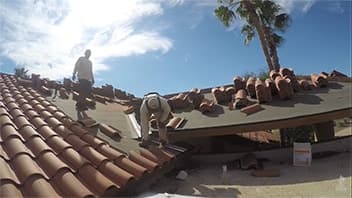
I have installed every major roofing material used in the Phoenix metro — concrete tile in Chandler, clay tile in Scottsdale, shingles in Mesa, foam on flat-roof homes in Tempe and central Phoenix. This comparison is based on what I have seen over 25 years, not on manufacturer claims or national averages that do not account for what an Arizona summer actually does to a roof.
Why Arizona Is a Different Roofing Environment
Roof surface temps hit 170°F in July. UV at Phoenix's latitude degrades asphalt 40% faster than temperate climates. Any material comparison ignoring Arizona conditions is using the wrong test.
Arizona roofing performance diverges significantly from national averages. Roof surface temperatures hit 170°F in July. UV intensity at this latitude breaks down polymer bonds in asphalt shingles 40% faster than temperate climates. Then monsoon season brings 60+ mph winds and 2 inches of rain in 30 minutes. Any material comparison that does not account for these conditions is not a useful comparison for a Phoenix homeowner.
There is also the HOA factor. Approximately 45–50% of Phoenix metro homeowners live under an HOA, and most planned communities specify roofing material in their CC&Rs. Material choice in Arizona is not just a performance decision — it is often a compliance decision first.
Concrete Tile
Lifespan (AZ)
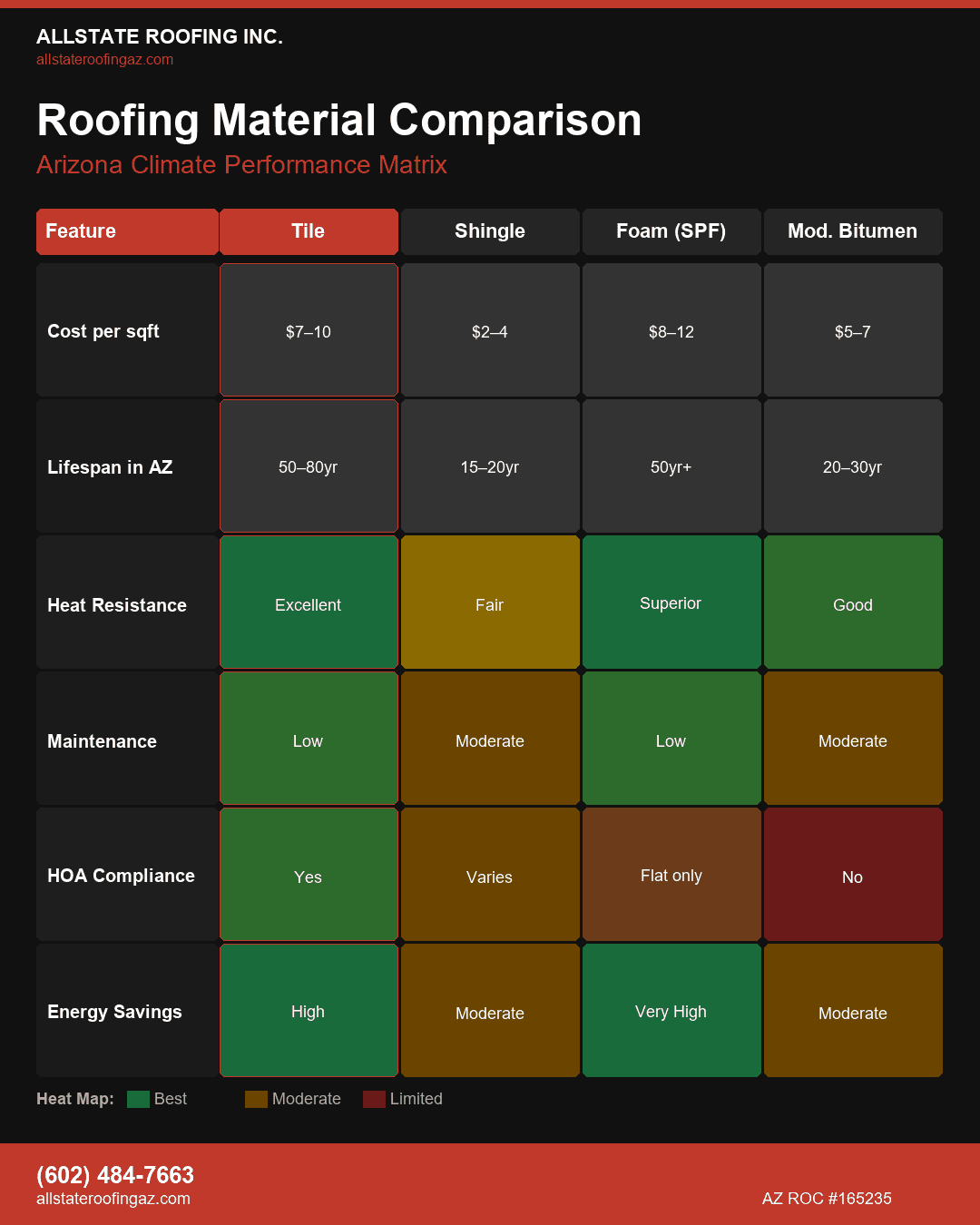
30–50 years
Install Cost
$10–$22/sq ft installed
Heat Performance
Excellent — air gap beneath tile provides passive insulation; reduces attic heat transfer up to 70%
Monsoon Rating
Very good — heavy, wind-resistant when properly mortared
UV Degradation
Minimal — cement-based; UV affects only surface color, not structural integrity
Cost Per Year (est.)
$0.28–$0.55/sq ft per year over 40-year lifespan
Pros
- Longest pitched-roof lifespan in Arizona climate
- Wide profile availability for matching
- Moderate cost vs clay tile
- Can be re-used in Tile R&R — tile outlives multiple underlayment replacements
Cons
- —Heavier than shingle — requires verified framing (8–12 lbs/sq ft vs 2–4 lbs for shingle)
- —Brittle — cracks from impact or foot traffic
- —Underlayment fails every 15–20 years regardless of tile condition
Clay Tile
Lifespan (AZ)
50–80 years
Install Cost
$15–$30/sq ft installed
Heat Performance
Excellent — better thermal mass than concrete; maintains cooler attic temperatures longer
Monsoon Rating
Very good — natural weight resists wind lift; heavy units at 9–12 lbs/sq ft
UV Degradation
Essentially none — fired clay has virtually zero UV degradation; color may fade minimally over decades
Cost Per Year (est.)
$0.25–$0.50/sq ft per year over 60-year lifespan
Pros
- Longest lifespan of any common Arizona roofing — outlasts 3–4 shingle replacements
- Authentic Southwestern architecture aesthetic
- Fire-resistant Class A rating
- Increases property value in premium markets
Cons
- —Highest material cost
- —Discontinued profiles are difficult to match — sourcing specialty tiles adds significant cost
- —Heavier than concrete tile — requires structural assessment
- —Brittle under impact — hail damage is common in eastern Valley storm corridors
Architectural Shingle
Lifespan (AZ)
20–25 years in Arizona
Install Cost
$6–$12/sq ft installed
Heat Performance
Moderate — reflective options available but still retains more heat than tile; no air gap insulation benefit
Monsoon Rating
Good when fastened correctly — degrades with age and UV; sealant strips fail on older shingles
UV Degradation
Significant — UV accelerates asphalt polymer breakdown 40% faster in Phoenix vs temperate climates; granule loss is the visible indicator
Cost Per Year (est.)
$0.32–$0.60/sq ft per year over 20-year lifespan (shorter AZ lifespan reduces cost efficiency)
Pros
- Lowest installation cost
- Wide availability and easy material matching for repairs
- Lighter — suitable for lighter framing that cannot support tile
- Easier to repair individual sections with standard labor
Cons
- —Shortest lifespan in Arizona due to UV degradation — 20-25 years vs national 25-30 year average
- —Granule loss accelerates with age — a 15-year shingle in Phoenix is typically degrading visibly
- —Not appropriate for low-slope roofs (under 2:12 pitch)
Spray Foam (SPF)
Lifespan (AZ)
50+ years with recoating
Install Cost
$6.50–$10/sq ft installed
Heat Performance
Best of any system — R-6.5 per inch insulation value; 2-inch application = R-13 continuous insulation; reduces HVAC cooling loads 20–30%
Monsoon Rating
Excellent — seamless application eliminates penetration points; monolithic system has no seams for water intrusion
UV Degradation
Coating (not foam) degrades — protective elastomeric coating needs recoating every 8–12 years; foam core essentially permanent
Cost Per Year (est.)
$0.34–$0.62/sq ft per year over 40 years (including recoating cycles)
Pros
- Best insulation value of any system — real, measurable HVAC load reduction in Phoenix summer
- Seamless — no penetration points; monolithic system
- Adapts to complex roof surfaces, multiple HVAC penetrations, irregular parapets
- Extends lifespan nearly indefinitely with recoating
Cons
- —Requires recoating every 8–12 years — non-negotiable maintenance requirement
- —Not appropriate for steep-pitch roofs
- —Appearance is functional, not attractive (textured white surface — typically not visible from street)
- —Damaged sections require professional repair with correct materials
HOA Material Restrictions — The Phoenix Reality
Most Phoenix metro HOA communities specify tile material, color, and profile in CC&Rs. Changing materials requires written approval and may be prohibited entirely.
Before choosing any roofing material in the Phoenix metro, check your HOA documents. This is the step most homeowners skip and the source of the most frustrating (and expensive) mistakes I see.
Most master-planned communities in the Valley — including most of Scottsdale, Chandler, Gilbert, Anthem, Surprise, and the Sun Cities area — specify tile in their CC&Rs. The specifications often include not just material type (concrete vs clay) but profile (flat tile vs S-tile vs barrel tile) and color family. Switching from the specified tile to shingle, metal, or any other material requires written ARC approval and in many communities is simply not permitted.
Communities where shingle is the standard (or acceptable) typically include: older Phoenix infill neighborhoods built before master-planned community expansion (1950s–1970s), some Mesa and Tempe neighborhoods from the 1980s, and communities where the CC&Rs specifically list shingle as an option. The rule of thumb: if your current roof is shingle and your neighbors all have shingle, your HOA likely permits it. If any neighbor has tile, your HOA may require it.
Energy Efficiency and Cool Roof Options
Tile reduces attic heat transfer 70% vs shingle. Foam delivers R-13+ insulation. Cool roof coatings cut surface temps 50–80°F. APS and SRP offer rebates for qualifying installs.
Energy efficiency matters more in Phoenix than almost anywhere in the country. When roof surface temperatures hit 170°F, the difference between a material that reflects that heat and one that conducts it into your attic translates directly to air conditioning cost.
Concrete and clay tile reduce attic heat transfer by up to 70% compared to asphalt shingles. The mechanism is the air gap created by the tile sitting on battens above the decking — that space creates a passive thermal buffer. It is not a high-tech feature; it is a function of how tile physically installs.
Spray foam provides R-6.5 continuous insulation per inch. A 2-inch foam application delivers R-13+ over the entire roof deck with no thermal bridges — HVAC load reduction of 20–30% is documented in Arizona residential applications. For flat-roof homes in Tempe, central Phoenix, or central Glendale, this is the most energy-efficient roofing system available.
Cool roof coatings — white or light-colored reflective coatings applied over existing flat roof systems — reduce surface temperatures by 50–80°F. Arizona Public Service (APS) and Salt River Project (SRP) both offer rebate programs for qualifying cool roof installations. Check current program terms before choosing materials; rebate availability changes year to year.
Metal Roofing in Arizona
Standing seam metal is an excellent Arizona performer but costs 50–100% more than tile and is rarely permitted in HOA communities that specify tile profiles.
Standing seam metal roofing has been gaining traction in Arizona custom home markets — particularly in Cave Creek, north Scottsdale, and contemporary architecture throughout the Valley. It performs well in this climate: the reflective surface reduces heat absorption, it is Class A fire-rated, it handles high winds well, and it lasts 40–70 years with minimal maintenance.
The main obstacles: cost (typically $12–$20 per square foot installed — 50–100% premium over standard concrete tile) and HOA restrictions. Most planned communities in the Phoenix metro specify tile in their CC&Rs, and metal is not an approved alternative in most of these communities without a specific variance. For custom homes on large lots without HOA, or in rural areas like Cave Creek, Carefree, or the Wickenburg corridor, metal is worth considering seriously.
If you are in an HOA community and interested in metal, check your CC&Rs and apply for a variance before getting quotes. Metal roofing is beautiful and durable, but it is not worth installing if it triggers an HOA violation.
The Bottom Line for Arizona Homeowners
Concrete tile is the best all-around choice for most Phoenix metro homes. Foam dominates flat roofs. Shingle is viable when budget or structure rules out tile.
For most Phoenix metro homeowners on a standard-pitch roof, concrete tile is the optimal balance of longevity, cost, HOA compliance, and Arizona performance. It is the dominant material in the Valley for good reason — it performs, it lasts, and it meets virtually every HOA requirement in the metro.
If you have a flat or low-slope roof, foam (SPF) is the best-performing system for Arizona conditions — full stop. No other flat roofing material matches its insulation value and seamless application in this climate. The maintenance requirement (recoating every 8–12 years) is real, but the total lifecycle cost is favorable compared to sequential modified bitumen replacements.
Shingle makes sense when budget is the primary constraint, when converting from tile is not feasible structurally, or when a shorter ownership horizon makes a 20-year material appropriate. Clay tile and metal are right for premium construction in the right markets — Scottsdale, Paradise Valley, Cave Creek, and custom homes throughout the north Valley.
The material decision is one we work through with every customer during the free assessment. We tell you what your HOA permits, what your structure can support, what the 20-year cost comparison looks like, and what we would install on our own home. You make the call with full information.
Material FAQs
What is the most popular roofing material in Arizona?
Concrete tile is the dominant residential roofing material in the Phoenix metro — it accounts for roughly 60–70% of all residential roofs. Clay tile is common in premium markets (Scottsdale, Paradise Valley, Cave Creek). Shingle is the most common in the more affordable developments from the 2000s–2010s. Foam roofing (SPF) dominates flat and low-slope residential and commercial roofs.
How long do roofs last in Arizona?
Clay tile: 50–80 years in the Arizona desert. Concrete tile: 30–50 years. Architectural asphalt shingles: 20–25 years in Arizona (shorter than national averages due to UV intensity). Spray foam (SPF): 50+ years with periodic recoating every 8–12 years. Metal standing seam: 40–70 years. Modified bitumen flat roofing: 15–20 years.
Is metal roofing a good choice in Arizona?
Metal standing seam is an excellent performer in Arizona — highly durable, fire-resistant, and reflective. The main drawbacks are cost (typically 50–100% more than tile) and aesthetic: it is not common in HOA-governed communities that specify tile profiles. In markets like Cave Creek and custom construction in north Scottsdale, metal is increasingly used on contemporary architecture.
Can I put any roofing material on my Arizona home?
It depends on your HOA and municipality. Most planned communities in Scottsdale, Chandler, Anthem, and the north Valley specify tile material, color, and profile. Changing to shingle or metal may require HOA approval and in some cases is not permitted. Check your CC&Rs before assuming a material change is an option.
What roofing material is most energy efficient in Arizona?
Spray polyurethane foam (SPF) has the best energy efficiency of any roofing system — R-6.5 per inch provides R-13+ continuous insulation over the entire roof deck, directly reducing HVAC cooling loads. Tile is the most energy-efficient pitched roof option because the air gap between tile and decking acts as passive insulation. Concrete tile reduces attic heat transfer by up to 70% vs. asphalt shingles.
Do HOA communities restrict roofing material choices in Arizona?
Yes — most planned communities in the Phoenix metro specify roofing material type, color, and profile in their CC&Rs. This is most restrictive in Scottsdale, Chandler, Anthem, and Gilbert communities. Before planning any material change, check your CC&Rs. Violations require removal and reinstallation at homeowner expense.
What is a cool roof and is it worth it in Arizona?
A cool roof uses highly reflective materials to reduce solar heat absorption. In Arizona, cool roof coatings on foam or flat roof systems reduce surface temperatures by 50–80°F compared to standard materials. For commercial buildings and flat-roof residential properties, the HVAC savings are meaningful — APS and SRP offer rebates for qualifying cool roof installations. For standard pitched tile roofs, the tile system already acts as a thermal buffer.