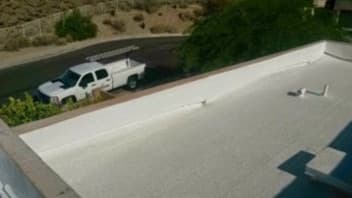
I have been installing foam roofs in the Phoenix metro since my father was doing them in the 1990s. Back then, foam was the contractor's secret — homeowners rarely asked for it by name. Now I get calls every week from people who heard foam lasts forever and want to know if it's true. The honest answer: it can, but only if you understand how the system works. This guide covers everything, including the parts foam salespeople sometimes leave out.
What Is SPF Foam Roofing?
Spray polyurethane foam (SPF) is a seamless, insulating flat roof system applied as a liquid that expands 30x on contact — no seams, no fasteners, no penetration points.
Spray polyurethane foam (SPF) roofing is a two-component chemical system — isocyanate and polyol resin — that is heated and mixed under high pressure in a proportioner rig and sprayed onto the roof surface through a specialized gun. When the two components combine at the nozzle, a chemical reaction occurs and the liquid expands approximately 30 times its original volume as it hits the surface, forming a rigid closed-cell foam.
The foam adheres to the substrate on contact and flows around penetrations, curbs, parapets, and irregular surfaces. There are no seams, no laps, no fasteners, and no separate flashing pieces. The system is monolithic — one continuous material from edge to edge and up every penetration.
Once the foam cures, an elastomeric coating — acrylic, silicone, or polyurethane — is applied in two passes with ceramic granules embedded in the top coat for UV resistance and foot traffic durability. That coating is the maintenance component. The foam below is essentially permanent. The coating is renewable every 8–12 years.
Why Foam Dominates Arizona Flat Roofs
Arizona's 170°F summer roof temps, extreme UV, and monsoon flash loads are exactly the conditions where foam's seamless, insulating design performs best.
Arizona is one of the worst climates on earth for conventional flat roofing. Modified bitumen and TPO membranes depend on seams and laps that are vulnerable to thermal cycling — Phoenix roofs can swing 100°F between a winter night and a summer afternoon. Every seam in a conventional membrane is a cycle-fatigue point. Foam has no seams to fail.
Arizona roof surfaces reach 160–170°F in summer. Foam's reflective white coating reduces surface temperatures significantly compared to dark modified bitumen, which can top 180°F. Less surface heat means less heat conducted into the building and less HVAC load.
The monsoon stress is the third factor. A Phoenix haboob drops 1–2 inches of rain in 20 minutes onto a flat roof. A flat roof with any seam weakness will leak eventually under that load. Foam's seamless design means there is no seam to fail under hydrostatic pressure — water can only exit through the drain.
Pros of Foam Roofing in Arizona
Eight real-world advantages — insulation, seamless design, adaptability, and lifecycle cost are the ones that matter most in this climate.
- Best insulation value of any roofing system — R-6.5 per inch reduces HVAC cooling loads significantly
- Seamless application — no seams, laps, or penetration points where water can enter
- Adapts to complex rooflines, multiple levels, and irregular surfaces without custom fabrication
- Can be applied over many existing systems, eliminating tear-off cost
- Lightweight — adds minimal dead load compared to tile or even modified bitumen
- Self-flashing around penetrations — HVAC curbs, pipes, skylights are integrated into the foam application
- Effectively indefinite lifespan with periodic recoating
- Cool roof performance — light-colored reflective coating reduces surface temps vs dark modified bitumen
Cons of Foam Roofing in Arizona
The recoating requirement is the one most homeowners miss — it is not optional, and skipping it is the most expensive mistake you can make with foam.
- —Requires recoating every 8–12 years — skipping this maintenance accelerates deterioration rapidly
- —Not suitable for steep-pitch or standard residential pitched roofs
- —Unattractive appearance — foam has a textured, off-white surface (typically not visible from street on flat roofs)
- —Overspray control required — wind drift during application can reach neighboring properties
- —Requires experienced application — poor foam mix ratios or application technique create long-term problems
- —Cannot be walked on heavily without damage — requires care during HVAC maintenance visits
- —Damaged sections require professional repair — DIY patching with wrong materials can trap moisture
- —Blistering, delamination, and ponding water are failure modes that compound quickly if ignored
The Recoating Reality
Recoating every 8–12 years at $2–$4/sq ft is what makes foam economics work — skip it and the lifetime cost advantage disappears fast.
The single most important thing to understand about foam roofing is the recoating requirement. It is not optional — it is the maintenance model that makes foam economics work. Every 8–12 years, the elastomeric coating that protects the foam from UV needs to be reapplied. This is a predictable, manageable cost: typically $2.00–$4.00 per square foot in the Phoenix metro.
Foam roofs that go unrecoated — typically because a homeowner did not know it was required, or deferred it indefinitely — eventually reach a state where the coating has degraded to the point that UV reaches the foam core. Once the foam begins to break down and absorb moisture, repair costs are substantially higher than the recoating that would have prevented it. I have seen roofs where the owner deferred recoating for 15 years. What would have been a $4,000 recoat became a $9,000 repair-and-recoat job.
Foam Roof Cost Over 40 Years (1,500 sq ft home)
| Item | Cost |
|---|---|
| Initial foam install (1,500 sq ft, 2-inch) | $10,000–$15,000 |
| Recoat at year 10 | $3,000–$6,000 |
| Recoat at year 20 | $3,500–$7,000 |
| Recoat at year 30 | $4,000–$8,000 |
| Total 40-year cost | $20,500–$36,000 |
Compare: modified bitumen on same roof replaced twice at $8,000–$14,000 each = $16,000–$28,000 with zero insulation benefit. Foam's 40-year total is higher but includes R-13 continuous insulation that reduces HVAC costs every single year.
Foam Roof Energy Savings in Arizona
SPF foam provides R-13 continuous insulation — Phoenix homeowners typically see 20–30% cooling cost reduction, and APS/SRP rebates can offset install cost.
A standard 2-inch foam application delivers R-13 continuous insulation over the entire roof deck with no thermal bridges. In a Phoenix summer where cooling accounts for 50–60% of a home's electric bill, roof insulation has a direct and measurable impact. Homeowners with foam roofs consistently report cooling bill reductions of 20–30% compared to the same home with uninsulated flat roofing.
APS and SRP both offer cool roof rebates. APS Cool Roof Rebate: $0.50 per square foot for qualifying reflective roof systems, which foam with a white elastomeric coating typically satisfies. SRP offers similar rebate structures through its energy efficiency program. On a 1,500 sq ft roof, that is $750 in rebates that reduce the effective install cost. Check current program terms at your utility directly — rebate structures update annually.
The energy savings compound over time. A homeowner who saves $600/year in cooling costs recoups the energy-savings portion of the foam install in 10–15 years. After that, the savings are pure offset against the recoating cost.
Common Foam Roof Failure Modes
Blistering, delamination, ponding, and UV exposure are the four failure modes — all are preventable with proper install and maintenance, all get worse the longer they are ignored.
Foam is not maintenance-free. When problems occur, they typically trace to one of four root causes. Catching any of these early keeps repair costs minimal. Ignoring them converts a small repair into a large one.
Blistering
Cause: Moisture in the substrate at time of application, or improper foam mix ratio
Signs: Bubbles or domes in the foam surface, hollow sound when tapped
Fix: Cut out affected area, dry substrate, refoam and recoat affected section
Delamination
Cause: Coating not bonded to foam — substrate contamination, wrong primer, application in wrong conditions
Signs: Coating peels or lifts away from foam surface in sheets
Fix: Remove delaminated coating, clean and prime foam surface, recoat
Ponding Water
Cause: Insufficient slope built into original installation, or settled drain area
Signs: Standing water more than 48 hours after rain, green algae staining
Fix: Add tapered foam to create positive drainage, recoat — ignoring ponding accelerates coating failure
UV Exposure
Cause: Coating worn through, typically from deferred recoating cycle
Signs: Yellow or orange foam visible, chalky coating surface, brittle foam in exposed areas
Fix: Recoat immediately if coating is thinned but foam is intact — replace foam sections if UV has degraded the core
Foam Inspection Schedule
Inspect twice a year — before monsoon season (June) and after (October). A qualified foam inspector looks at coating thickness, adhesion, and drainage in a 20-minute walkthrough.
Foam roofs should be inspected twice a year: once in late spring before monsoon season begins (typically late May or June), and once in October after monsoon season ends. The pre-monsoon inspection confirms the coating is intact before the high-stress period. The post-monsoon inspection catches anything the season opened up.
What a Foam Inspection Covers
- Coating thickness measurement in multiple locations — confirms adequate UV protection remains
- Adhesion check — look for delamination, lifting, or bubbling
- Penetration inspection — HVAC curbs, pipe boots, skylights checked for foam-to-penetration seal
- Drainage paths confirmed — verify drains are clear and foam slope is directing water
- Ponding water evidence — green staining, algae, or tide marks indicate drainage issue
- Impact damage — foot traffic damage from HVAC service calls, hail dimpling post-monsoon
- Parapet and edge termination — confirm foam-to-wall transition is intact
Commercial vs Residential Foam in Arizona
Commercial foam installs run larger and use thicker applications (3–4 inches) — the system is the same but commercial has more code oversight and longer warranty requirements.
SPF foam is used on both residential flat roofs and commercial buildings throughout the Phoenix metro. The chemistry is the same — the differences are in application thickness, coating specs, code requirements, and warranty structure.
Residential foam typically uses 1.5–2 inch applications on flat or low-slope sections of single-family homes and townhomes. Common in central Phoenix bungalows, older Tempe ranch homes with flat additions, Scottsdale custom homes with multi-level flat roofs, and any home where the primary or secondary roof section is flat.
Commercial foam applications are larger and often spec 2.5–4 inch thickness to meet commercial energy codes. Commercial buildings also require foam systems that carry Underwriters Laboratories (UL) fire ratings and often have specific warranties in lease agreements. The contractor qualifications for commercial foam are more stringent — manufacturer certification is typically required.
One important distinction: a contractor qualified for residential foam installs is not automatically qualified for commercial. If you are bidding a commercial building, ask specifically for manufacturer certification documentation. Allstate Roofing handles both residential and commercial foam in the Phoenix metro — the crews and equipment are the same; the documentation and warranty packages differ.
How to Choose a Qualified Foam Contractor
Own proportioner rig, verifiable SPF experience, and product data sheets on the coating system — these three things separate qualified foam contractors from general roofers doing foam as a side job.
Foam roofing is a specialty trade. The learning curve for proper application is steeper than shingle or tile work, and mistakes made during install are not visible until the roof starts failing — sometimes years later. Here is how to evaluate a foam contractor before signing anything.
Foam Contractor Qualification Checklist
- Verify AZ ROC license — confirm it covers roofing, not just general contracting
- Ask how many foam installs per year — fewer than 20 residential installs annually is a thin track record
- Ask if they own or rent a proportioner rig — contractors who subcontract the spray work cannot control the install quality
- Request product data sheet on the coating system — generic or off-brand coatings are a red flag
- Ask about manufacturer certification — SPF manufacturers like Lapolla, Gaco, and Sika certify applicators
- Request references from foam installs that are 5+ years old — ask if they performed the recoat
- Get a written recoating schedule in the contract — any contractor who will not commit to a recoat schedule in writing is selling, not servicing
- Ask about their moisture assessment process — confirm they probe before foam-over-existing applications
When Foam Is the Right Choice
Flat or low-slope roofs with complex penetrations, where insulation performance matters and the owner will maintain the recoat schedule — foam wins every time in those conditions.
Flat or low-slope residential roofs. Any roof with a pitch under 2:12 is a foam candidate. This includes the Tempe near-ASU neighborhoods, central Phoenix bungalows, older Glendale ranch homes, and commercial buildings throughout the metro.
When insulation performance matters. If cooling costs are significant, foam's R-13+ continuous insulation layer provides real, measurable HVAC load reduction — nothing else in flat roofing delivers that performance.
Complex rooflines. Multiple-level roofs, extensive HVAC penetrations, unusual parapets, and irregular surfaces that would require extensive custom fabrication in other systems are handled naturally by foam's spray application.
When the existing system is still sound. Foam-over-existing eliminates the tear-off cost — sometimes $1,500–$3,000 on a residential job — when the substrate is confirmed dry and structurally adequate.
Owners who will maintain it. If the homeowner understands the recoating requirement and treats it like a scheduled maintenance item rather than an unexpected expense, foam is the best long-term roofing investment available for flat roofs in Arizona.
When Foam Is Not the Right Choice
Steep-pitch roofs, moisture-compromised substrates, and owners unwilling to maintain the recoat cycle — foam will underperform or fail in all three scenarios.
Steep-pitch roofs. Foam does not adhere properly to steep-pitch surfaces and is not engineered for that application. Tile and shingle remain the correct systems for pitches above 2:12. Contractors who claim foam works on steep-pitch are either misinformed or overselling.
Owners who will not maintain it. Foam requires the recoating schedule. A buyer who will not commit to periodic maintenance is better served by a system with a simpler lifecycle — modified bitumen or TPO with a 20-year replacement cycle is more appropriate than foam that deteriorates from deferred recoating.
When the existing substrate has moisture. Foam applied over a wet substrate traps that moisture and creates long-term delamination and blistering problems that emerge years after install. A thorough moisture assessment — probing or infrared scan — is required before any foam application.
HOA-restricted properties. Some Phoenix HOAs have material restrictions or appearance standards that effectively prohibit foam on visible roof sections. Verify your HOA's CC&Rs before proceeding with a foam quote. The cost of an HOA dispute after the foam is installed is substantially higher than checking beforehand.
Foam Roofing FAQs
How long does a foam roof last in Arizona?
SPF foam itself is extremely durable — the foam core can last 50+ years. The limiting factor is the elastomeric coating on top of the foam. That coating degrades from UV exposure and typically needs recoating every 8–12 years. With regular recoating, a foam roof can last indefinitely. Without recoating, the UV eventually reaches the foam core, which begins to break down and absorb water — at that point, repair is much more expensive than the recoating that would have prevented it.
What does foam roof recoating cost in Arizona?
Recoating a foam roof in the Phoenix metro typically runs $2.00–$4.00 per square foot. On a 1,500 sq ft flat roof, that is roughly $3,000–$6,000 every 8–12 years. Compare this to modified bitumen flat roofing, which typically needs full replacement every 15–20 years at $8,000–$14,000 for the same roof. Over a 40-year period, foam with regular recoating is significantly less expensive than sequential modified bitumen replacements.
Can foam roofing be applied over an existing flat roof?
Often yes — foam can be applied directly over a sound existing flat roof system, which eliminates tear-off and disposal costs. However, the existing system must be dry and structurally sound. Any existing moisture in the roof assembly must be addressed before foam application. We perform moisture probing before quoting any foam-over-existing application.
Is foam roofing good for Arizona heat?
Foam roofing has the best heat performance of any commercial or residential roofing system available. SPF foam provides R-6.5 insulation per inch of thickness — a 2-inch application provides R-13 continuous insulation over the entire roof deck, eliminating thermal bridges. This directly reduces HVAC cooling loads in a way that no other flat roofing system can match. Phoenix homeowners with foam roofs consistently report lower summer electric bills after installation.
What are the signs a foam roof needs recoating or repair?
The main warning signs are: visible foam exposure where the coating has worn through, blistering or bubbling in the coating surface, standing water that does not drain within 48 hours after rain, cracking or alligatoring in the coating, and soft or spongy areas underfoot that indicate moisture in the foam. If you see any of these, get an inspection before the next monsoon season — waiting compounds the damage and the cost.
How do I find a qualified foam roofing contractor in Phoenix?
Verify Arizona ROC license and confirm it covers roofing (not just general contractor). Ask specifically for SPF foam experience — ask how many foam installs per year and request references. A qualified foam contractor should own or rent a proportioner rig (the high-pressure heated machine that mixes and sprays the two-component foam) rather than subcontracting it. Ask about their coating system and who makes it. Cheapest bid is often the most expensive foam job long-term.